






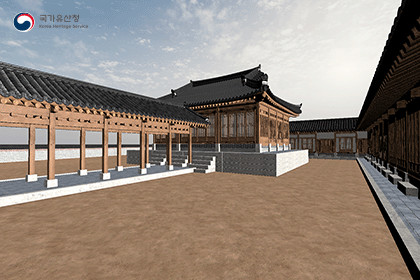
These 3D assets were produced by Korea Heritage Service as a project to build raw resources for the production and supply of Korean heritage digital contents in 2024.For commercial use, you can mark the 'Korea Heritage Service' as the source.KOREA HERITAGE SERVICE [KHS]The Korea Heritage Digital Service is a service that releases various national heritage data, so that companies, regions, and the public can easily find high-quality national heritage data. It is expected to be of great help to the public as well as companies, local governments, universities and research institutes by releasing national heritage data such as 3D data, drawings, photos, reports and videos that are difficult for the public to access.You can easily access the data by using conditional search functions such as designated items, regions, eras and production years, and also can easily check information such as 3D scanned videos and web VR contents provided by Korea Heritage Service through services such as '3D Asset' and 'Theme Contents'.Gyeongbokgung Palace 경복궁Gyeongbokgung Palace, the main palace in the Joseon Dynasty, was built after King Taejo, founder of the Joseon Dynasty. He had the capital moved to Hanyang during the fourth year of his reign (1395). Its name, literally meaning “great fortune,” originated with a phrase of Sigyeong (Book of Songs), quoted by Jeong Do-jeon, an eminent scholar in the Joseon Dynasty: "I've already drunk and have been full with virtue, so I will help you get great fortune in my late year as a man of virtue.”Mungyeongjeon, Gyeongbokgung Palace 문경전This is the building of Gyeongbokgung Palace. It was northwest of Gyeongbokgung Palace and southeast of Taewonjeon. It is a soul hall. Honjeon is a place where the king, queen, and queen dowager held memorial tablets until the end of the three-year mourning period after their deaths. Since Honjeon was intended to be used briefly during state funerals, a separate building was not built, but some buildings in Pyeonjeon or Chimjeon were used. Then, in the 1860s, when Gyeongbokgung Palace was rebuilt, a separate building was built exclusively for marriage, and if the queen died during the king's lifetime, the memorial tablet could be kept in the place where it was originally enshrined and only after the king's death could it be enshrined in Jongmyo Shrine, so it was prepared for a line portrait. To do this, two battlements were built.Features:Complex of MungyeongjeonNumber of Unique Meshes: 116Collision: YesVertex Count: 5 - 227,625LODs: NONumber of Material Instances: 17Number of Textures: 49Texture Resolutions: (1024*1024, 2048*2048, 4096*4096)Supported Development Platforms:Windows: (Yes)Mac: (No)